
How Vollna's AI Job Qualifier Stops You Wasting Connects on Upwork
There's a familiar feeling every serious Upwork freelancer knows: you spend connects on a job that looked right, the proposal disappears into silence, and you're left wondering what went wrong. Do it enough times and it stops feeling like bad luck.
According to data from GigRadar's 2026 analysis, the real cost per hire on Upwork ranges from $60 to $240+ in connects alone, depending on your reply rate and close rate. That's not pocket change — and most of that spend goes on jobs that were never a fit to begin with.
Vollna's AI Job Qualifier exists specifically to fix this. Here's how it actually works.
Why keyword filters alone aren't enough
Upwork's native search filters — and even most third-party tools — work on structured fields: budget ranges, client location, hire rate, payment verification. Those are useful. But the real information is in the job description itself, and that's where standard filtering breaks down.
Consider a common scenario: you're a Next.js developer who's excluded "WordPress" from your searches. A client posts a $12,000 project to migrate their WordPress site to a Next.js headless CMS. That job never reaches you — even though WordPress is the problem they're solving, not the deliverable you'd be building.
Flip it the other way: a job is tagged "React developer needed" with a matching budget. You apply. But the description reveals they want a project manager to run standups and report to stakeholders. The keyword matched. The role didn't.
This is exactly the gap Vollna's AI Job Qualifier was built to close.
What the AI Job Qualifier actually does
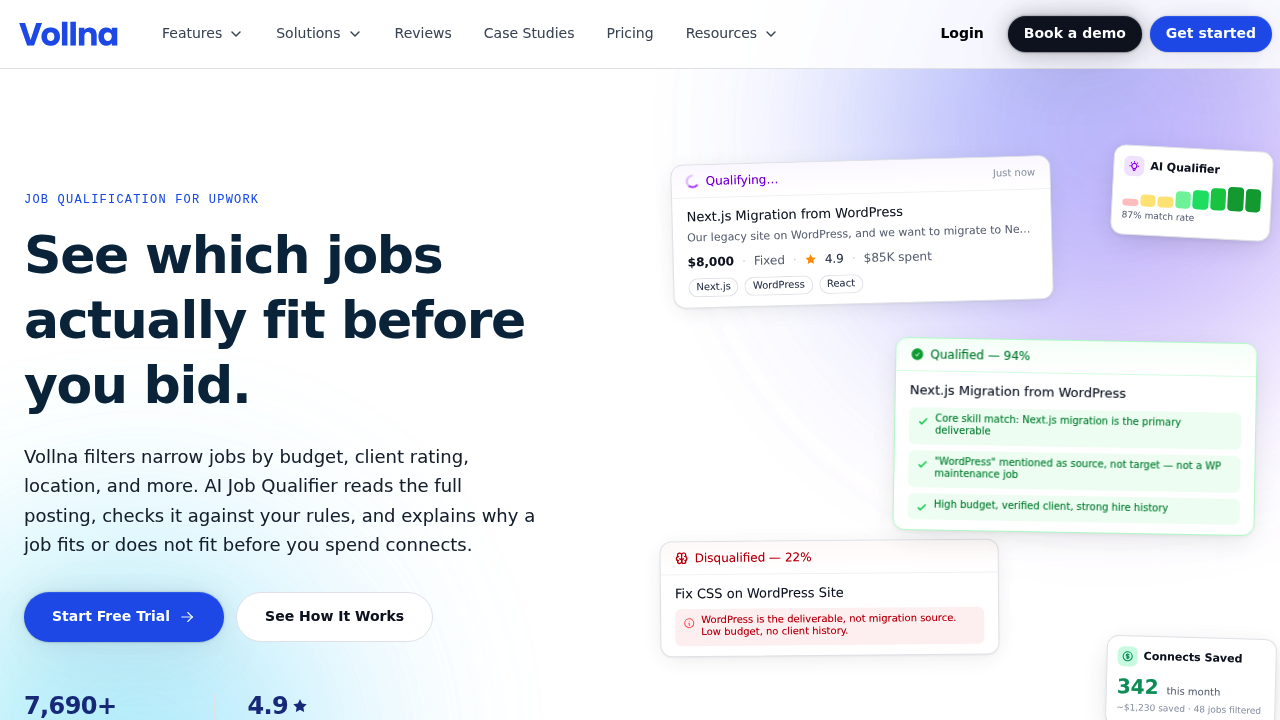
When a new job passes your initial 30+ attribute job filters, the AI Qualifier takes over. It reads the full posting — title, description, skills, client questions, budget, and client work history — then checks everything against rules you've written in plain language.
You write something like: "We're a Next.js/React agency. Skip jobs under $1,000 fixed or $30/hr. Only qualify clients with verified payment and $1K+ spent. Skip 'WordPress' unless it's a migration source."
The qualifier applies those instructions to every matching job and returns a score with clear reasoning. A 94% score comes with an explanation: "WordPress mentioned as legacy source. Core deliverable is Next.js migration — perfect match for your stack." An 18% score tells you exactly why: "Core deliverable is WordPress. Doesn't match your stack."
This isn't keyword matching. It's reading for intent.
Four things it catches that filters miss
Real skill fit vs. tag mismatch. A job tagged "Flutter" that actually needs a React Native developer. A "UX design" post where the client buried "we'll handle the coding" mid-description — meaning it's a pure design role you'd have filtered out by mistake.
Scope and complexity. A $5,000 budget can mean a real SaaS build or a glorified bug fix. The qualifier reads scope signals: greenfield vs. legacy maintenance, clear spec vs. "message me for details," serious engagement vs. a one-liner.
Red flags in the description. Commission-only pay. Equity instead of cash. Agencies hiring white-label subcontractors. Vague scope that signals endless revision loops. These almost never appear in filter fields — they live in the copy.
Context reversal. When a keyword you'd normally exclude is actually the source of the problem the client is escaping, not the deliverable. This is where most keyword-only approaches cost freelancers real money.
The numbers behind it
Agencies using Vollna's AI Job Qualifier report saving 40%+ on wasted connects after enabling it. The qualifier's average accuracy sits at 92% — well beyond what keyword matching produces. And because you're only applying to well-matched jobs, proposals land more relevantly: reply rates reported by users run at 2x compared to broad keyword-based bidding.
On Vollna's dashboard, you can see the impact month over month: connects saved, qualification breakdown, and top disqualification reasons. One sample agency saw 342 connects saved in a single month from 48 disqualified jobs — roughly $1,230 at current connect pricing.
For freelancers working through the manual bidding system, the score and reasoning also function as a decision aid: you review the qualifier's logic before spending a single connect, rather than re-reading every full posting yourself.
How it connects to the rest of Vollna
The qualifier doesn't operate in isolation. Jobs that score above your threshold feed directly into Vollna's auto-bidding workflow, where AI-generated proposals go out automatically — personalized using your profile, work history, and the specific job context. Jobs that score below your threshold are skipped, with connects untouched.
For agencies managing multiple freelancers, the qualification criteria can be tailored per feed, and the dashboard shows per-user analytics on connect spend, view rates, and hire outcomes. This is covered in detail in the 2026 Upwork automation guide for anyone running a team workflow.
Refinement is built into the loop. Review the qualifier's decisions, disagree with a call, adjust your prompt — and the accuracy improves. Most agencies hit 90%+ qualification accuracy within the first two weeks of tuning their criteria.
What this means for your connect budget
Connects cost $0.15 each, but that's never the real number. Your actual cost per hire is a function of how often you apply to jobs you shouldn't. A freelancer closing 1 in 20 proposals pays roughly $48 per hire in connects. One closing 1 in 100 pays closer to $240 (according to SnipeWork's 2026 analysis). The variable that changes that ratio most reliably isn't proposal quality alone — it's job selection.
A tool that reads the full posting, checks it against your rules, and flags bad fits before you bid turns qualification from a manual chore into an automated checkpoint. That's time back, money saved, and proposals going only where they have a real chance.
If you want to see the qualifier in action for your niche, Vollna offers a free trial with no commitment. You can also review how writing stronger Upwork cover letters pairs with better job selection to push reply rates further — because both matter once you're sending proposals to the right jobs.
The platform now has over 7,690 freelancers and agencies relying on it, with a 4.9 average rating. That's not coincidence — it's what happens when you stop treating connects as the cost of doing business and start treating them as something worth protecting.