
Choosing the Right Team Personality Assessment Tool
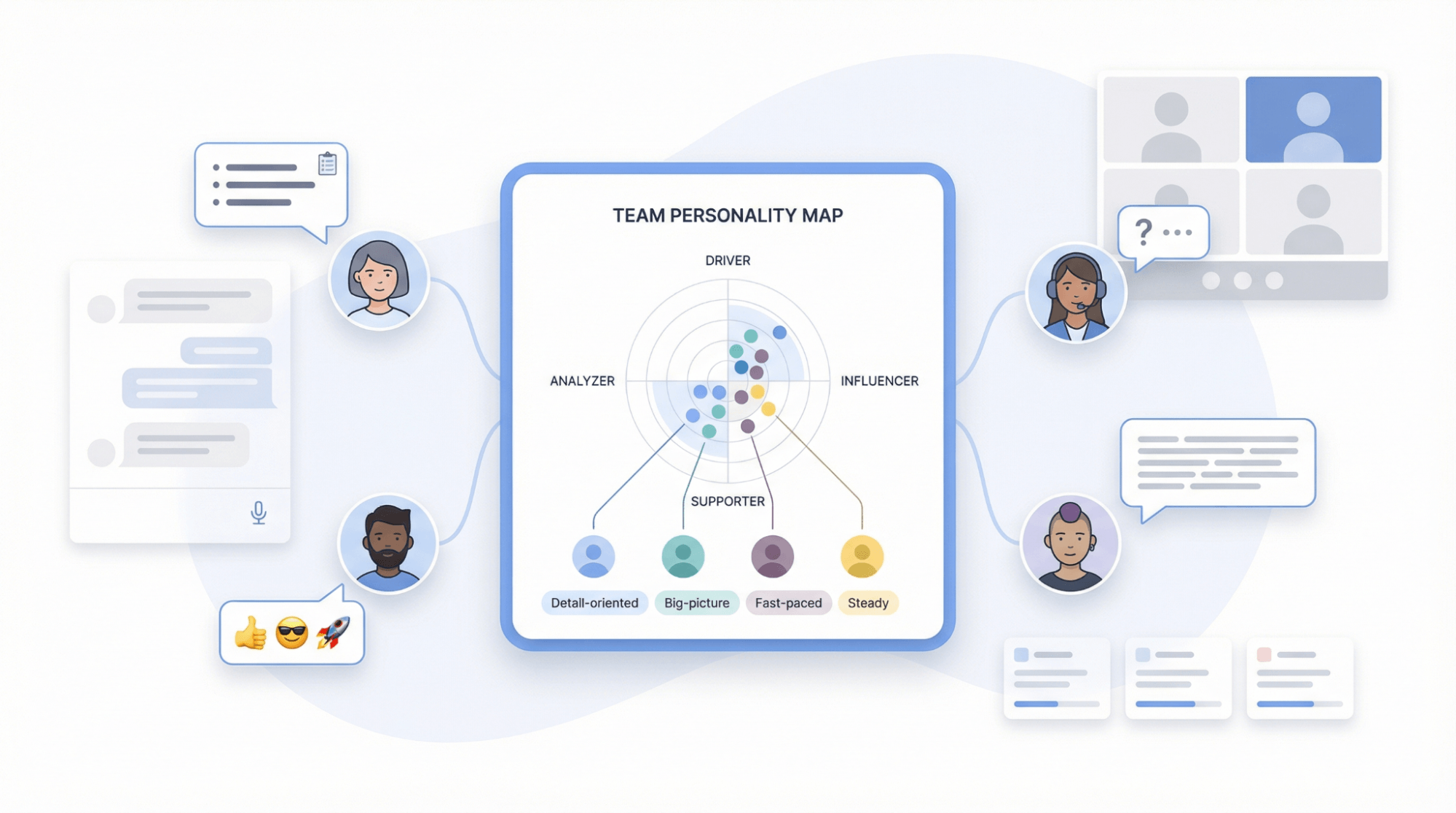
Remote and hybrid work have fundamentally changed the way we collaborate. We no longer share the same walls, yet we still bump into the same misunderstandings—now in Slack threads or Zoom calls instead of conference rooms. Without hallway cues or office energy to “read the room,” a team-personality assessment can shift from being a novelty to being a practical tool for alignment.
The market has exploded. What once sat on consultants’ shelves is now packaged into dashboards, AI coaching apps, and team-mapping platforms. But not all assessments are equal, and not every team needs the same level of depth or complexity.
This guide helps you cut through marketing noise, understand the real value assessments can offer distributed teams, and choose a tool that fits your culture, budget, and workflow.
Ready? Let us decode the science of team chemistry and find the assessment that turns personality data into everyday performance.
Why team-personality assessments matter for small and remote teams
Trust and clarity get tested when your entire workspace lives in chat, not a hallway. A missed message or blunt Jira comment can snowball into missed deadlines or lost clients.
A validated assessment hands the team a neutral map of work styles. A terse bullet-point reply looks like high Conscientiousness instead of coldness, while an emoji-rich post signals Influence rather than frivolity. Shared language trims misinterpretations and lowers social friction.
It also speeds role fit. If a three-person startup sees that none of them score high on Detail Orientation, they can budget for contract QA before bugs hit revenue. Larger remote groups can blend idea-driven and execution-driven profiles in the same pod, balancing brainstorms with follow-through.
The business case is strong. In a multi-company Gallup study, workgroups that adopted strengths-based development posted 10–19 percent higher sales and up to 16 percent lower turnover in low-turnover environments. For a five-person team, avoiding even one resignation can pay for the assessment.
Finally, transparent insight boosts psychological safety. When teammates understand not just what colleagues do but why they do it, they speak up sooner, listen longer, and keep momentum across time-zone gaps.
How we evaluated: a practical rubric
Method beats guesswork, so we scored each tool against seven factors that matter to distributed teams. The percentage beside each factor shows its weight in the final score.
- Actionable insights (20 percent). Does the platform turn results into next-day experiments?
- Scientific validity (20 percent). Is the model supported by peer-reviewed research or large field datasets?
- Ease of rollout (15 percent). Short survey, no required facilitator, clear dashboard.
- Team-level analytics (15 percent). Individual scores help; heatmaps shift behavior.
- Value for money (15 percent). We weigh price against feature depth and shelf life of the data.
- Adoption and support (10 percent). Onboarding resources, an active user community, and nudges that keep the data alive.
- Privacy and compliance (5 percent). Alignment with GDPR, CCPA, and role-based access.
We rated each criterion on a 1–10 scale, multiplied by its weight, then added the totals. Feel free to copy the framework for the next assessment that lands in your inbox.
The quick-scan matrix
Need the shortlist fast? The table below pares each tool to the details most teams ask first.
|
Tool |
Core focus |
Typical price |
Best for |
Stand-out strength |
|
TeamDynamics |
Team-level behavioral type |
$39 per user, one time |
Hybrid teams under 20 people |
Actionable rituals baked into the report |
|
MBTIonline Teams |
Classic 16-type preferences |
about $100 per user |
Quick team bonding |
High familiarity, no facilitator needed |
|
CliftonStrengths |
Individual talents (34 themes) |
$25–$60 per user |
Aligning roles to strengths |
Positive, engagement-boosting language |
|
Everything DiSC |
Four-style communication map |
about $90 per profile |
Day-to-day collaboration |
Catalyst app for on-demand comparisons |
|
Predictive Index |
Behavioral fit and talent strategy |
from $5k per year (org license) |
Fast-growing firms |
Links hiring data to team design |
|
Enneagram |
Nine core motivations |
$10–$20 per user |
Deep empathy sessions |
Sparks candid EQ conversations |
|
Hogan Suite |
Strengths, derailers, values |
$150–$250 per user |
Executive or high-stakes teams |
Research-grade risk insight |
Tip: Circle two or three options that fit your budget and pain points, then jump to their detailed sections for a closer look.
1. TeamDynamics: best for ongoing team alignment
TeamDynamics focuses on team-level behavior rather than individual personality traits, making it particularly well-suited to remote teams that need immediate clarity about how they communicate and work together. According to the document you provided, it identifies a team’s unique type—one of sixteen possible combinations—based on how the group communicates, processes information, makes decisions, and executes work. The platform then delivers these insights through a dynamic, shareable report designed for retros, team conversations, and leadership alignment.
Each person also receives a “CoDynamics” profile showing how their own working style supports or diverges from the team’s overall pattern. The assessment takes only a few minutes, and pricing is straightforward: a one-time fee of thirty-nine dollars per user for teams of two to twenty, or twenty-nine dollars for individuals. TeamDynamics intentionally avoids integrations to minimize technical overhead—no HRIS setup, no IT involvement, and no configuration required. Its biggest value is simplicity and fast adoption, although it is a newer tool with less published validation than older assessment systems.
2. MBTIonline Teams: best for instant common language
MBTIonline Teams provides the official digital experience of the Myers–Briggs Type Indicator, presenting each participant with a four-letter type that describes preference patterns such as introversion/extraversion or thinking/feeling. Many teams appreciate MBTI because it’s familiar and easy to discuss, making it a natural starting point for improving empathy and understanding. The online team portal visualizes all team members’ types together, making it easy to identify patterns or hotspots in communication.
However, MBTI’s psychometric limitations are well documented. It shows low test–retest reliability, meaning an individual’s “type” can shift on repeat attempts, and its ability to predict performance or workplace outcomes is limited. MBTIonline Teams therefore works best as a conversation tool rather than a diagnostic or selection instrument. It can build rapport and awareness, but teams should avoid using it for hiring or performance decisions.
MBTIonline Teams costs USD $99.95 per person for teams of three or more, making it cheaper than a consultant-led workshop while still offering far more depth than free quizzes.
Choose this option if your remote group wants a quick empathy boost before the next stand-up.
3. CliftonStrengths: best for building a strengths-based culture
CliftonStrengths takes a positive approach by identifying what each person naturally does best. Instead of assigning fixed personality categories, it highlights an individual’s top talent themes—often used to clarify roles, improve engagement, and help team members lean into their strengths. This strengths-based framing tends to boost morale and can help teammates appreciate one another’s unique contributions without emphasizing deficits.
Because CliftonStrengths focuses exclusively on strengths, it does not identify blind spots, friction points, or possible communication challenges. As a result, it may need to be supplemented with a behavior-focused tool if the goal is to address conflict or misalignment. When teams apply CliftonStrengths only at the individual level, its impact is limited; the greatest value comes from integrating the insights into how tasks are assigned and how the team collaborates.
4. EverythingDiSC: best for smoother day-to-day communication
EverythingDiSC uses a simple four-style behavioral model—Dominance, Influence, Steadiness, and Conscientiousness—to explain how people communicate and respond to pressure. Because of its simplicity, many remote teams find it especially helpful for addressing misunderstandings that arise from tone, pacing, or communication preferences. DiSC offers concrete, memorable guidance on how to adjust your approach when working with teammates of different styles.
Its simplicity, however, is also its limitation. Reducing human behavior to four quadrants can overlook nuance, and DiSC is not designed to predict job performance or guide hiring. It is most effective when teams use it to improve daily communication patterns, for example by setting expectations around meeting styles, messaging tone, or decision-making approaches. When used this way, it can significantly reduce everyday friction.
Individual Workplace profiles start at USD $90 each, with volume discounts down to $73.50. No certification is required, and a library of micro-learning modules keeps the language fresh long after launch.
5. The Predictive Index: best for data-driven hiring and scaling
The Predictive Index offers a more data-driven approach, combining behavioral drive assessments with optional cognitive measures and job-fit tools. PI excels in linking people strategy with business strategy, making it a strong choice for organizations that want to align hiring, team composition, and long-term workforce planning. It can show how a team’s collective profile aligns with its goal—such as speed, innovation, or precision—and highlight where gaps may hold the team back.
For small or early-stage teams, the Predictive Index may feel heavy. It requires training or a “PI Champion” to interpret correctly, and the costs—often starting around several thousand dollars per year—are difficult to justify without broader organizational adoption. PI works best in growing companies that expect to scale rapidly and need consistency in how they hire, structure teams, and make strategic decisions.
Annual licenses start at USD $4,950 and include training a certified “PI Champion.” The price makes sense for companies scaling past roughly 50 employees or handling high-stakes projects; a five-person startup will find lighter tools on this list more cost-effective.
Pick PI if you want one language from hire to retire: predictive hiring, team gap analysis, and strategy alignment in a single platform. For very small teams, the price and learning curve may outweigh the benefits.
6. Enneagram: best for deep emotional insight
The Enneagram focuses on the motivations and fears that drive behavior, going deeper into emotional dynamics than tools like DiSC or MBTI. Teams often use it to understand conflict patterns, uncover hidden sources of tension, and strengthen psychological safety. When discussed openly, Enneagram insights can spark meaningful conversations that shift team culture and improve trust.
The Enneagram is best positioned as a tool for culture and empathy—not hiring, evaluation, or performance measurement.Because the model probes personal wiring, discussions can feel intimate. Set ground rules, allow opt-outs, and frame the goal as mutual understanding rather than diagnosis. Teams that run facilitated Enneagram sessions often report jumps in psychological safety; one leadership workshop lists it as a primary outcome of its team report program.
However, The Enneagram lacks the psychometric polish of Big Five tools and offers no built-in dashboards. Treat it as a dialogue starter, not a performance predictor. It is ideal when trust feels thin or tension hides behind polite emojis, and a single candid session can reset the emotional climate for months.
7. Hogan Personality Suite: best for high-stakes leadership insight
The Hogan assessments form one of the most research-backed frameworks in organizational psychology. The suite includes three major components: everyday personality strengths, behavioral derailers that surface under stress, and core values that shape long-term motivation. This combination provides a comprehensive view of leadership potential, risk factors, and cultural fit, making Hogan a trusted tool in executive development and succession planning.
However, Hogan’s depth comes with complexity. Results often require a certified facilitator to interpret accurately, and the assessments can be costly compared to other team-focused tools. Hogan is best reserved for contexts where decisions are high-stakes—such as leadership development, executive hiring, or major organizational transitions—rather than everyday collaboration within small remote teams.
Plan on about $200–$250 per assessment report plus facilitation fees. That price can sting for a five-person founder team, but for a board steering a nine-figure exit it is affordable insurance.
Choose Hogan when reputational risk is high, decisions are complex, and egos need a trusted referee. It will not make strategy calls for you, but it will surface the personality landmines that can derail them.
Emerging tools worth a look
A few newer platforms are moving the category forward. Pilot them with a small group, and ask each vendor for validation data before a full rollout.
- Cloverleaf combines multiple assessments (MBTI, DiSC, Strengths, Enneagram) and sends daily micro-coaching tips to Slack or Microsoft Teams. The small-team Coach plan is free for up to three users, and paid tiers start at USD $12–$15 per user per month for deeper analytics and AI coaching.
- Crystal uses AI to predict DiSC styles from public LinkedIn data and provides pre-meeting playbooks. The Premium plan costs $49 per user per month (billed annually), while a limited free tier includes five profile look-ups.
Both tools focus on continuous, just-in-time coaching. Peer-reviewed validation is still limited, and costs can rise as your headcount grows, so treat them as helpful add-ons rather than core diagnostics for now.
Conclusion
Choosing the right team-personality assessment is ultimately about choosing the right level of insight for the moment your team is in. Small and remote groups don’t need enterprise-grade psychometrics to make meaningful progress—they need shared language, fast clarity, and tools that translate immediately into better communication and smoother workflows. Whether you lean toward a strengths-based lens like CliftonStrengths, a behavior map like DiSC, a strategic system like The Predictive Index, or a team-focused model like TeamDynamics, the true value comes not from the report itself but from how consistently your team applies the insights.
The best assessment is the one your people will actually use—during retros, while assigning work, or when giving feedback across time zones. Treat these tools as catalysts, not verdicts. Let them spark conversations that make invisible dynamics visible, encourage curiosity rather than assumptions, and align your team around how they want to work together. With the right fit and steady follow-through, a single assessment can become a long-term advantage—turning personality data into everyday performance and transforming distributed teams from loosely connected contributors into a coordinated system that works with momentum, not against it.